Showing posts with label Duke University ALS Clinic. Show all posts

Saturday, November 12, 2016

Macgyvering, not Reaganing


Recently Pat and I  were invited to participate in a living with disabilities discussion with people smarter than we who will be inventing things to make people like us have better lives.  They were Duke students of Professor Kevin Caves  (he is the go to tech guy at the DUKE ALS clinic and what he doesn't know about technology isn't worth knowing).

We were asked beforehand about concerns.  One of the questions was, what is the number one thing you'd like to be able to do now that you used to be able to do?  I was stunned by Pat's answer. I thought it would be walk, drive, pick up a grandchild.  No, his answer was  "I want to pee in private."

There is something that you can buy on Amazon called a condom catheter, and it is exactly what it says. It is a condom, but instead of keeping dangerous bodily fluids in, it has a hole on the bottom that you attach to one of those bladders you put on the patients leg or hang from the bedside.  While  I shopped online, I noticed there are no SMALL sizes available.  You can only get medium/large, which is a hoot. I guess since men in these positions can no longer compensate by driving silly cars and outrageous boats, the world has to give them this small consolation.

Now if you remember from a post awhile back, one of Pat's larger concerns when finding out he had a fatal illness that would destroy his muscles and render him an immovable body losing control of his life,  was.."who is going to maintain my beard?"  Although I, however am happy if I have clean underwear on when I get killed in a car wreck; I knew that strapping a bag of urine on his leg wasn't going to work for my stylish guy.

Again, Amazon came to the rescue. We found wine bags that  hide the bladders quite nicely. Then the problem arose that because it wasn't attached to the leg, the urine backed up onto his chair, rendering my meticulous man, wet and stinky.  AHA! pool noodles.  I cut one of those styrofoam pool noodles in half creating a reasonable facsimile of a lower leg,  wrap the bladder around it and  hide it in the bag.
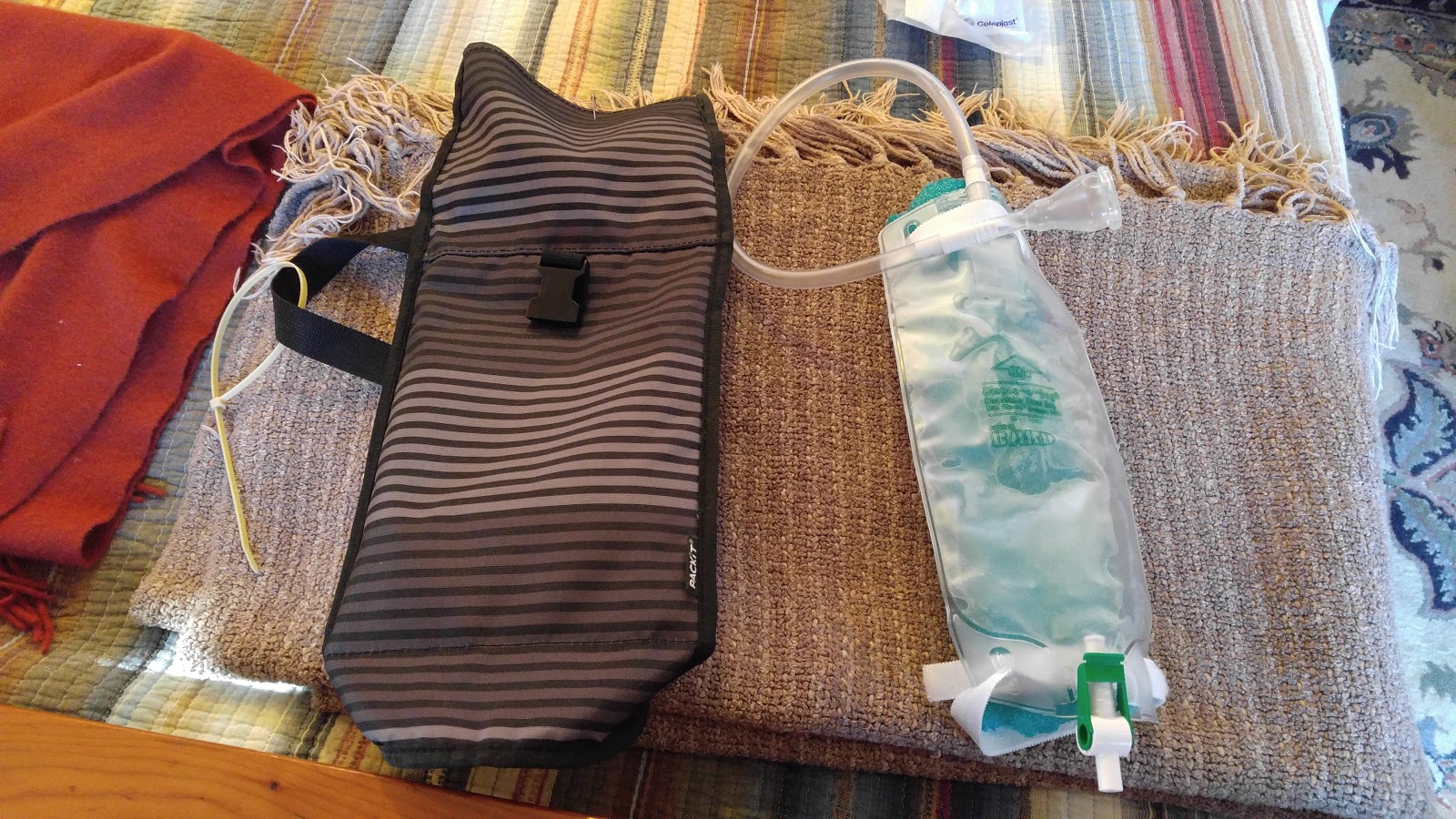


For the first time in over 4 years, Pat can pee in private!


Wednesday, October 16, 2013

Square Pegs

The neighborhood where I walk in the mornings has very old pin oaks lined up between the sidewalk and the street.  Their growth area is about two and half feet across, which leads to an interesting phenomena.  The massive trees are all rectangular.  It's a good object lesson for young children starting to discover nature and then trying to capture it on paper.  They assume trees are round, but, if you show them the trees of Davis street, they will see another sort.  You can't quite fit that round tree into that rectangular plot of ground.

Amyotrophic Lateral Sclerosis is like that.  It just doesn't quite fit into any clear category. And, like those trees it seems to morph into something else, and unfamiliar.  In fact, when our daughter and I attended the ALS conference in Durham last year, the keynote speaker, Dr. Richard Bedlack of the Duke ALS clinic (and Pat's doctor) spoke to that.  He said the more they learn about ALS, the less they know.  They're not even sure if it is a true motor neuron disease.

No one even knows how many people have ALS.  That's why it is so important for those who have managed to be diagnosed with it get on the ALS registry.  In numbers, there is power.

http://www.alsa.org/als-care/als-registry/

ALS was first diagnosed by a French Dr. Charcot and until our favorite baseball player told us he was the luckiest man in the world, it was known as "Charcot's Disease."

Here's the link to the Wikipedia page if you're interested.

http://en.wikipedia.org/wiki/Amyotrophic_lateral_sclerosis

My point  here now is that AIDS/HIV was unknown until really the 1980s and now it is in many cases considered a chronic disease due to medical advances. That has only been 30 years... The sheer numbers or lack of them often determine whether or not a disease will be tackled by the major pharmaceutical companies.  We've known about ALS for over 150 years.